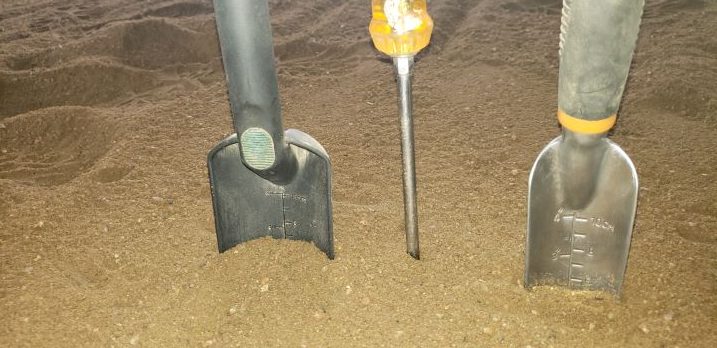
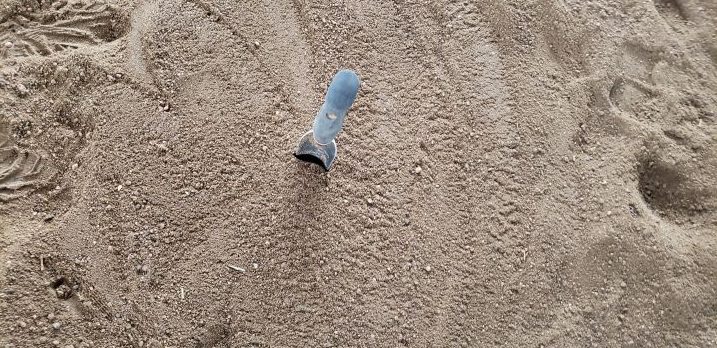
To make accurate dust suppression CALCULATIONS AND ESTIMATES for any area (any arena, any round-pen, stall, run, walker or paddock etc) requires recording accurate measurements. Most arenas, stalls and runs are rectangles (square is a special rectangle) with or without rounded corners. It is critical to accurately know the VOLUME and PHYSICAL CONDITION of material to be treated. SURFACE AREA for rectangular arenas, stalls and runs with right-angled corners is calculated by multiplying the width times the length. If the corners are rounded/ curved, it too can be calculated. SURFACE AREA for circles such as round-pens or walkers uses the formula pi*r2. VOLUME is determined by multiplying surface area times “average depth” of the loose material. Accurately determining the average depth measurement is critical. Being off true-measurements “by a little” can result in being off “by a lot,” as explained below.
Measurements can ONLY lead to one of three possible outcomes. The first outcome is an “under-application”. The second outcome is an “optimum economical application”. And, the third outcome is an “over-application”. The first application is called the “initial” application. Follow-up applications are called “maintenance” applications. With use, the footing is crushed into smaller and finer particles under the hoof of the horse. This exposure creates more surface area. Arena Rx’s superior viscosity-indexing allows it to self migrate over these newly exposed surface areas. However, eventually with ongoing use, customer’s are encouraged to call for a maintenance application on an as-need basis. These maintenance applications usually happen when dust “first” begins to reappear. Since Arena Rx does not evaporate and remains in and on the footing particles, maintenance applications require fewer gallons than the initial application. With an initial optimum economic application, the time until the first maintenance application is about 12 – 14 months, sometimes less, sometimes more based on several other factors.
In general, we are here to listen, to ask questions, so we can best understand the specific needs and the goals that the customer wants to achieve. Usually, a customer prefers an optimum, economical dust control application that has long-term significant benefits. Although uncommon, a customer may knowingly and deliberately prefer to purchase more product (e.g., considered as an over-application amount). This strategy is usually based on future savings related to freight costs, something similar. Even more-rare is the customer who knowingly and deliberately purchases less than the optimal economical application amount. In this situation they only need a short-term benefit. Regardless, in all situations, we can explain the advantages and the disadvantages, so the customer can make an informed decision.
On the other hand, when a customer actually wants and optimum economical application, but provides inaccurate information or measurements, it can lead to an unintended over-application or under-application. Since Arena Rx “Clean Air for Horse and Rider does not evaporate, the results of an over application simply extends the time between an initial and a follow-up maintenance application. Conversely, the results of an under application shortens the time until a maintenance application is needed. So, “Being off true-measurements “by a little” can result in being off “by a lot,” is explained. For example purposes only, let’s presume the “true” overall average depth is 3.0″. However, it is measured and reported as 2.5″. This GIGO number (a poor quality input number will always produce a faulty output number) is then entered into calculations. Result is a 17% under-estimation and application of the “true” gallons actually needed for an optimal economical application. With all other factors being equal, this means a “maintenance application will be needed sooner. On the other hand, it is measured and reported as 3.5”. This GIGO number is then entered into calculations. Result is a 12.5% over-estimation and application of the “true” gallons actually needed for an optimal economical application. With all other factors being equal, this means the time will be extended until a “maintenance application” is needed.
From 2004 to 2014, I personally experimented on my own arena to observe timeline variations between deliberate under-applications, deliberate optimum-economical applications, and in 2010 one deliberate over-application. By doing this, I have real-world, first-hand knowledge of the outcomes.
In summary, it all starts with and requires accurate measurements! We are happy to discuss your dust suppression or soil stabilization issues and answer your question.